The swelling eased within a few days, and movement became much easier. I was pleased that the improvement lasted longer than the short courses of treatment I had tried before.
Depo-Medrol
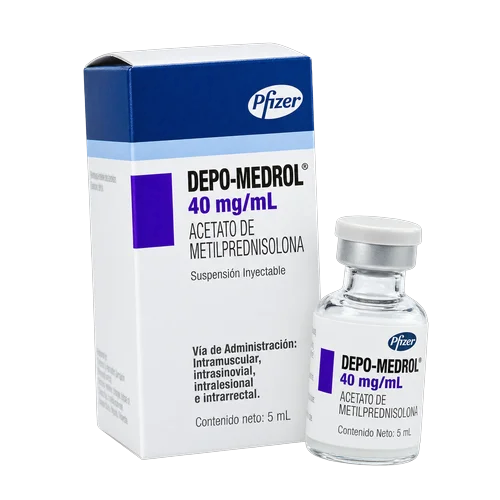
Depo-Medrol is supplied as an injectable suspension for administration by a qualified healthcare professional. It contains methylprednisolone acetate for inflammatory, allergic, rheumatic, and autoimmune conditions when a corticosteroid injection is clinically appropriate. The acetate formulation forms a depot at the injection site, allowing prolonged glucocorticoid activity.
Overview
Depo-Medrol contains methylprednisolone acetate, a synthetic corticosteroid and glucocorticoid. The product supplied for this page is a 40 mg/mL injection in a vial. Methylprednisolone acetate reduces excessive inflammation and alters immune activity in conditions where the body’s inflammatory response causes tissue damage, swelling, pain, or restricted movement.
Pharmacological classification of glucocorticoids
Glucocorticoids are corticosteroid hormones that act on intracellular glucocorticoid receptors. After entering cells, methylprednisolone influences gene transcription and reduces the production of inflammatory mediators such as cytokines and prostaglandin-related substances.
This action can reduce:
- Tissue swelling and inflammatory pain
- Excessive immune-cell activity
- Redness, heat, and local irritation
- Inflammation around joints, tendons, skin, and other tissues
- Symptoms linked to some allergic and autoimmune disorders
The same mechanism explains the principal limitations. Glucocorticoids can suppress protective immune responses, raise blood glucose, affect fluid balance, and influence bone, muscle, mood, and adrenal function when exposure is substantial or repeated.
Therapeutic indications
Depo-Medrol may be prescribed when inflammation requires corticosteroid treatment and a depot injection is appropriate. The final decision depends on the diagnosis, severity, affected tissue, previous treatments, infection risk, and the patient’s medical history.
Clinical uses can include selected cases of:
- Inflammatory joint disease
- Osteoarthritis with significant local inflammation
- Bursitis and synovitis
- Tendon-sheath inflammation
- Severe musculoskeletal inflammatory disorders
- Certain dermatological inflammatory conditions
- Severe allergic states
- Selected autoimmune or immune-mediated disorders
A local injection aims to concentrate treatment near the affected structure. An intramuscular injection exposes the body to systemic corticosteroid activity and may be chosen when several areas are involved or when oral treatment is impractical. The duration of benefit varies by route and treated tissue. Follow-up helps determine whether the response justifies further treatment.
Depo-Medrol does not remove the underlying cause of every inflammatory condition. It reduces inflammatory activity while the wider treatment plan addresses the diagnosis. Infection, uncontrolled diabetes, poorly controlled hypertension, osteoporosis, glaucoma, and previous steroid complications can change the risk–benefit assessment.
Mechanism of action
The active substance is related pharmacologically to methylprednisolone, the corticosteroid used in oral Medrol tablets. The acetate form is less water-soluble, so it remains at the injection site and is absorbed gradually. This depot effect can provide longer activity than a rapidly eliminated corticosteroid preparation. [1]
Reasons not to use it
The injection is generally unsuitable when there is:
- A known serious allergy to methylprednisolone, corticosteroids, or an excipient
- A systemic fungal infection
- An infection at the intended injection site
- A prosthetic joint infection or suspected septic arthritis
- An untreated infection in the structure being injected
- A need for intravenous corticosteroid treatment
- A need for intrathecal administration
Live or live-attenuated vaccines require special attention during substantial immunosuppressive corticosteroid treatment. The response to vaccination may also be reduced.
When this is not for you
Depo-Medrol is not for you if you have an active infection, a serious corticosteroid allergy, or require an administration route that this suspension does not support.
Extra caution is needed with:
- Diabetes mellitus
- Uncontrolled hypertension
- Heart failure or significant fluid retention
- Osteoporosis
- Glaucoma
- Peptic ulcer disease
- Epilepsy
- Severe mood disorders or previous steroid psychosis
- Tuberculosis exposure
- Liver disease
- Kidney disease
- Pregnancy or breastfeeding
- Children and adolescents
The injection may be unsuitable for a person with an active infection unless the infection is being specifically managed and the treating clinician considers corticosteroid treatment necessary.
Unwanted effects
Side effects depend on the dose, injection site, number of injections, interval between treatments, route, and the person’s susceptibility to corticosteroids. A single local injection may produce fewer systemic effects than repeated intramuscular treatment, though systemic absorption can still occur.
Local effects
Possible local reactions include:
- Temporary pain or tenderness
- Bruising or mild swelling
- Skin thinning or a change in skin colour
- Loss of subcutaneous fat near the injection site
- Infection
- Reduced tendon strength or tendon injury if injected into or too close to a tendon
- A temporary increase in joint pain after injection
Pain that becomes severe, redness that spreads, marked warmth, drainage, fever, or rapidly increasing swelling requires prompt medical assessment because infection can resemble an inflammatory flare.
Systemic effects
Systemic corticosteroid effects can include:
- Temporary blood glucose elevation
- Increased appetite
- Fluid retention and ankle swelling
- Raised blood pressure
- Indigestion
- Sleep disturbance
- Mood changes, irritability, or unusual excitement
- Headache or dizziness
- Reduced resistance to infection
- Menstrual changes
- Muscle weakness with repeated exposure
Repeated or prolonged corticosteroid exposure can contribute to osteoporosis, cataracts, glaucoma, skin fragility, adrenal suppression, and changes in body-fat distribution. Children and adolescents require additional care because repeated systemic corticosteroid exposure can affect growth.
Corticosteroids can mask infection. A person may feel less pain or fever while an infection continues to develop. This is one reason why new fever, persistent cough, worsening urinary symptoms, or a hot and swollen joint should not be dismissed after treatment. [2]
Formulation
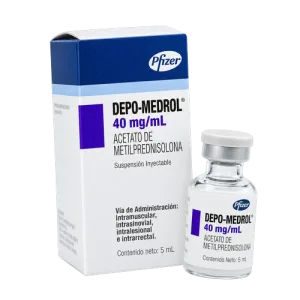
Depo-Medrol is an injectable suspension containing methylprednisolone acetate at 40 mg/mL. It is supplied in a vial and is intended for professional preparation and administration.
The formulation is a suspension rather than a clear solution. This difference matters because the particles must be evenly distributed before the dose is prepared. A healthcare professional also selects the amount according to the route, anatomical site, diagnosis, previous corticosteroid exposure, and response to treatment.
The product may be considered for:
- Intramuscular administration when systemic corticosteroid treatment is required
- Intra-articular injection into a suitable joint
- Injection into selected soft-tissue structures
- Local treatment of some inflammatory or allergic conditions
Not every route is suitable for every condition. A dose chosen for a joint cannot automatically be transferred to an intramuscular treatment plan.
Directions for use
Depo-Medrol is administered by a trained healthcare professional. It is not a self-injection product for routine home use.
The route depends on the clinical objective:
- Intramuscular injection: used when systemic corticosteroid exposure is required.
- Intra-articular injection: placed into a selected joint by a clinician familiar with joint anatomy and injection technique.
- Soft-tissue injection: used for selected inflamed structures, such as a bursa or tendon sheath, when clinically appropriate.
The suspension must not be administered intravenously. Methylprednisolone acetate is a depot suspension, and its formulation is not designed for injection into a vein. It is also unsuitable for intrathecal administration.
Exact anatomical placement matters. Injection into the wrong tissue can reduce benefit and increase the risk of tendon injury, tissue atrophy, nerve injury, vascular injury, or infection. A clinician should also avoid injecting directly into a tendon and should use extra caution around weight-bearing structures.
A missed appointment should not be managed by arranging a replacement dose independently. The treating clinician decides whether the injection remains appropriate and whether the interval needs to change.
Handling and preparation considerations
The vial is prepared for injection by a healthcare professional. A suspension requires appropriate mixing before withdrawal so that the methylprednisolone acetate is distributed consistently.
A clinician checks the injection site for local infection, reviews recent corticosteroid exposure, and confirms whether the intended route is intramuscular, intra-articular, or soft tissue. These practical checks are more than routine: local infection and incorrect placement can turn a useful anti-inflammatory treatment into a serious complication.
Comparison
Depo-Medrol and oral Medrol both contain methylprednisolone-related corticosteroid treatment, but their pharmaceutical behaviour differs. Depo-Medrol contains methylprednisolone acetate in a depot injection. Medrol tablets contain methylprednisolone for oral administration and are adjusted according to a planned daily schedule.
Prednisolone is another oral glucocorticoid with a different active substance. It can be useful when clinicians need a flexible daily dose, rapid adjustment, or a gradual taper. Depo-Medrol may be considered when a depot injection is clinically appropriate and adherence to daily oral treatment is difficult or oral treatment is unsuitable.
| Treatment category | Route and practical feature | Main limitation |
|---|---|---|
| Depo-Medrol | Injection; depot release from the injection site | Once administered, the exposure cannot be rapidly removed |
| Oral Medrol | Oral methylprednisolone; dose can be adjusted day by day | Requires regular dosing and may cause gastrointestinal or systemic effects |
| Prednisolone | Oral glucocorticoid with flexible dose adjustment | May require tapering after longer treatment and can produce systemic steroid effects |
Depo-Medrol is not automatically stronger simply because it lasts longer. The clinically useful choice depends on the diagnosis, target tissue, required speed of control, infection risk, and the ability to change treatment quickly. The FDA prescribing information distinguishes depot methylprednisolone acetate from soluble corticosteroid preparations by formulation and route. [3]
Common mistakes
Several avoidable errors can reduce benefit or increase risk:
- Treating a depot injection as equivalent to a daily oral steroid
- Forgetting to mention a previous steroid injection
- Taking naproxen or another NSAID regularly without reporting it
- Failing to disclose diabetes or home glucose readings
- Assuming reduced pain proves that an infection has resolved
- Requesting repeat injections before the underlying diagnosis is reviewed
- Exercising a painful tendon aggressively soon after a local injection
- Ignoring new fever, spreading redness, or severe swelling
- Omitting the injection from a medication history during emergency treatment
- Assuming a local injection has no systemic effects
One practical detail is easy to miss: symptom improvement can outlast the patient’s memory of the injection date. Recording the date prevents later clinicians from underestimating how recently corticosteroid exposure occurred.
What doctors say
In clinical practice, doctors often view depot corticosteroid injections as targeted tools rather than routine replacements for diagnosis or long-term disease control. The injection can reduce inflammation when a specific structure is involved, yet repeated injections may increase local tissue damage or systemic steroid exposure.
A physician will usually consider four practical questions:
- Is inflammation the main cause of the symptoms?
- Is infection reasonably excluded?
- Would local treatment provide a meaningful advantage over oral treatment?
- Can the patient be monitored for glucose, blood pressure, mood, bone, and infection effects?
The answer may differ between a single inflamed joint and a systemic autoimmune flare. A depot injection also has limited reversibility: once given, clinicians cannot simply remove the dose if mood symptoms, glucose elevation, or an infection develops.
What customers often ask
Can Depo-Medrol be used during pregnancy or breastfeeding?
Pregnancy and breastfeeding require an individual assessment because corticosteroids cross the placenta and methylprednisolone-related exposure can enter breast milk in small amounts. The benefit of treating significant maternal inflammation may outweigh the potential risk, while unnecessary or repeated exposure should be avoided. The 2022 EMA product information for systemic corticosteroids and MHRA guidance support using the lowest clinically appropriate exposure when treatment is necessary. [4]
Can Depo-Medrol be combined with NSAIDs or dapsone?
Depo-Medrol can sometimes be used alongside another medicine, but the combination requires review of the person’s diagnosis and risk factors. Naproxen and other NSAIDs can increase gastrointestinal ulcer or bleeding risk when combined with systemic corticosteroid exposure. Dapsone requires attention to infection, blood-cell effects, and the reason both treatments are being used; the prescriber should also review anticoagulants, diabetes medicines, and immunosuppressants, consistent with the FDA's 2023 prescribing information.
Is Depo-Medrol suitable for people under 18?
Use in children and adolescents is decided by a specialist or appropriately trained clinician. Repeated or substantial systemic corticosteroid exposure can affect growth, bone health, blood pressure, glucose, and adrenal function. Paediatric corticosteroid guidance from the WHO and national medicines regulators supports careful dose selection and monitoring based on body size, diagnosis, route, and duration. The WHO's 2022 guidance also supports monitoring growth and adrenal function.
What happens if the expected result does not occur?
A lack of improvement should prompt a clinical reassessment rather than an automatic repeat injection. The diagnosis may be different, the inflammation may not be the main cause of symptoms, or infection may need to be excluded. The clinician may review the injection site, timing, route, imaging, blood tests, and alternative treatments before deciding what happens next. The FDA's 2023 prescribing information supports reassessing the diagnosis and treatment response before repeat exposure.
How long does a course last, and is long-term use acceptable?
There is no single course length that suits every patient because dosing differs between strengths, routes, diagnoses, and individual response. Some patients receive one injection, while others need a carefully spaced treatment plan with review before each dose. Long-term or repeated corticosteroid exposure can cause adrenal suppression, osteoporosis, glucose elevation, infection risk, eye complications, and local tissue damage, so repeated treatment requires documented clinical justification and monitoring. The FDA's 2023 prescribing information also describes these risks with repeated corticosteroid exposure.
Do you offer anonymous delivery?
Your order will be securely packed and shipped within 24 hours. This is exactly what your package will look like (images of an actual item sent). It has the size and look of a regular private letter (24x11x0.7 cm) and its contents cannot be seen.
Comparison
How Buyers Rate Depo-Medrol
The injection made everyday walking more manageable. The benefit was gradual rather than immediate, but I noticed a clear difference during the following week and was satisfied with the result.
It reduced the pain, but the improvement was only partial and took longer than I expected. I also had disturbed sleep for several nights, so I stopped assuming that another injection would automatically be the best next step.
Sources
- U.S. Food and Drug Administration (2023). Depo-Medrol (methylprednisolone acetate injectable suspension) Prescribing Information.
- Pfizer (2023). Depo-Medrol Medical Information: Methylprednisolone Acetate Injectable Suspension.
- U.S. National Library of Medicine (2024). DailyMed: Methylprednisolone Acetate Injectable Suspension.
- European Medicines Agency (2022). Guideline on the clinical investigation of medicinal products for the treatment of inflammatory and autoimmune diseases.