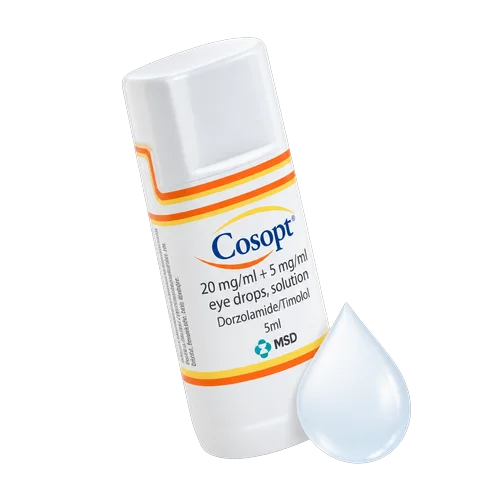
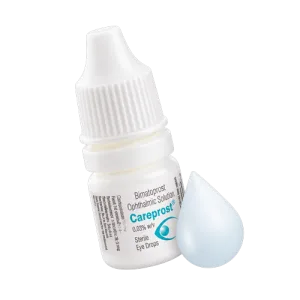
I used Cosopt twice a day for several months. My follow-up pressure readings were lower, and I found the single bottle easier to remember than separate morning and evening drops.
Cosopt eye drops are applied topically to the eye and are used to lower raised intraocular pressure in glaucoma or ocular hypertension. The solution combines dorzolamide and timolol to reduce aqueous humour production and help protect the optic nerve from pressure-related damage.
Overview
Cosopt is an ophthalmic solution supplied in a bottle for application into the affected eye or eyes. Its therapeutic purpose is pressure control in people with open-angle glaucoma or ocular hypertension, conditions in which persistently raised intraocular pressure can injure the optic nerve.
Therapeutic indications
Cosopt may be prescribed for:
- Open-angle glaucoma requiring more than one pressure-lowering mechanism.
- Ocular hypertension, where eye pressure is elevated without established optic-nerve damage.
- Patients whose pressure remains above target with a single topical medicine.
- Patients who benefit from combining two active ingredients in one bottle.
The aim is not to improve vision instantly. The aim is to reduce the pressure that contributes to progressive optic-nerve injury.
Regular pressure checks and consistent use of prescribed drops remain central to protecting visual function, as reflected in NICE guidance on glaucoma diagnosis and management [1].
Mechanism of action
The two ingredients act at different points in the ciliary body. This dual action can lower intraocular pressure more than either mechanism alone in patients who need combination treatment. The FDA prescribing information describes the pharmacology, dosing principles, warnings, and systemic absorption of dorzolamide-timolol ophthalmic solution [2].
Role of timolol maleate
Timolol blocks beta receptors in the ciliary epithelium. This reduces sympathetic stimulation that would otherwise support aqueous humour production. Less newly formed fluid generally means lower pressure inside the eye.
Although timolol is placed in the eye, some of the dose can enter the bloodstream through the nasal passages. This explains why an ophthalmic beta-blocker can affect breathing, pulse, or blood pressure in susceptible people.
A practical technique reduces systemic absorption: close the eye gently after applying the drop and press the inner corner of the closed eyelid for about two minutes. This blocks part of the drainage pathway into the nose without rubbing the eye.
Role of dorzolamide hydrochloride
Dorzolamide inhibits carbonic anhydrase in the ciliary processes. This enzyme contributes to bicarbonate formation and ion movement involved in aqueous humour secretion. By reducing this activity, dorzolamide decreases fluid production within the eye.
Dorzolamide may cause local stinging, burning, blurred vision, or a bitter taste after drainage into the throat. A brief bitter taste does not mean the medicine has failed. Nasolacrimal occlusion can reduce this sensation and may also limit systemic exposure.
Reasons not to use it
Specific situations requiring avoidance or specialist review include:
- Asthma or a previous episode of severe bronchospasm.
- Severe chronic obstructive airway disease.
- Sinus bradycardia or certain heart-block disorders.
- Overt or uncontrolled heart failure.
- Severe kidney impairment, especially because dorzolamide and its metabolites rely on renal clearance.
- Previous severe reactions to sulfonamide-related medicines.
- Active eye inflammation or significant corneal disease requiring a different treatment plan.
Clinically relevant interactions may occur with oral beta-blockers, calcium-channel blockers, digitalis-related medicines, anti-arrhythmic drugs, clonidine, and medicines that slow the heart rate.
Other carbonic-anhydrase inhibitors can increase exposure to the same pharmacological class. Combining them without a clear prescribing plan may increase adverse effects. Diabetes also deserves attention because beta-blockers can mask some warning signs of low blood glucose, such as a fast heartbeat.
Unwanted effects
Cosopt can cause local eye effects and systemic beta-blocker effects. Many reactions are mild and short-lived, yet persistent or severe symptoms need prompt medical attention.
Common or clinically recognised reactions include:
- Burning, stinging, or irritation after application.
- Watery eyes or eye redness.
- Temporary blurred vision.
- A bitter taste.
- Dry eyes.
- Headache or tiredness.
- Slower pulse or lower blood pressure.
- Shortness of breath in susceptible people.
- Corneal sensitivity changes.
Brief blurred vision immediately after a drop can make driving unsafe until clear vision returns. The drop itself can also leave a taste in the mouth because the tear duct drains into the nose and throat.
Serious symptoms require urgent medical assessment. These include wheezing, marked breathlessness, fainting, chest discomfort, severe swelling, sudden vision change, intense eye pain, or signs of a severe allergic reaction.
The European Medicines Agency describes the importance of considering systemic beta-blocker effects even when timolol is administered as an eye drop [3]. People who already use beta-blocker tablets may need a review of their combined exposure.
One easily missed detail is the bitter taste. Gentle eyelid closure and pressure at the inner eye corner can reduce drainage into the throat. Another is temporary visual blur; it usually matters most when driving, reading small print, or operating machinery immediately after application.

Formulation
Cosopt contains dorzolamide hydrochloride and timolol maleate. The product is an eye-drop solution supplied in a 5 ml bottle. The amount used can differ between strengths and between users, so there is no single amount that suits everyone. Dorzolamide belongs to the carbonic-anhydrase inhibitor class, while timolol is a beta-adrenergic receptor blocker.
| Ingredient | Drug class | Main pressure-lowering action |
|---|---|---|
| Dorzolamide hydrochloride | Carbonic-anhydrase inhibitor | Reduces aqueous humour formation |
| Timolol maleate | Beta-blocker | Reduces aqueous humour secretion |
Directions for use
Cosopt is administered as eye drops. The exact regimen varies with the strength, the number of affected eyes, the pressure target, and the person’s response; there is no single amount that suits every user.
A commonly prescribed schedule is:
- Apply one drop to the affected eye or eyes twice daily.
- Space the doses roughly morning and evening.
- Keep the bottle tip away from the eye, eyelashes, fingers, and skin.
- Close the eye gently after application.
- Press the inner corner of the closed eye for about two minutes.
- Leave at least ten minutes between Cosopt and another eye drop unless the prescriber gives different instructions.
If a dose is missed, apply it when remembered unless the next scheduled dose is close. In that situation, skip the missed dose and return to the usual timetable. Do not apply two doses together.
When several eye medicines are prescribed, the order can matter less than the interval between products. A thicker gel or ointment is usually used after liquid drops because it can interfere with absorption of a subsequently applied solution.
Do not stop pressure-lowering treatment abruptly without a replacement plan. A return of high intraocular pressure may be silent, so the absence of discomfort is not a reliable guide.
Comparison
Ophthalmologists choose between single-agent drops, fixed combinations, and other pressure-lowering approaches according to the type of glaucoma, target pressure, response, tolerability, and coexisting conditions. A therapeutic alternative must match the prescribed active ingredients and strength; similar-looking bottles are not automatically interchangeable.
Combination options can reduce the number of separate applications compared with using two individual drops. They may also simplify a complicated regimen. The limitation is that one bottle contains two pharmacological actions, so an adverse effect from either ingredient may require a change in the whole combination.
| Treatment approach | Main feature | Typical clinical consideration |
|---|---|---|
| Dorzolamide plus timolol combination | Carbonic-anhydrase inhibition plus beta-blockade | Useful when both mechanisms are appropriate |
| Separate dorzolamide and timolol drops | Same mechanisms in separate products | Allows each ingredient to be adjusted independently |
| Single-agent pressure-lowering drop | One pharmacological mechanism | May be suitable when pressure responds adequately to one medicine |
Other glaucoma medicines may lower pressure through increased fluid drainage rather than reduced fluid production. Prostaglandin-related drops, alpha-adrenergic agonists, and other carbonic-anhydrase inhibitors have different benefits and limitations. The choice depends on the pressure goal and the person’s ocular and general health.
Common mistakes
Several avoidable errors can reduce the amount of Cosopt reaching the eye:
- Applying two drops because the first one was not felt.
- Missing the inner-corner pressure technique.
- Using the drops at irregular times.
- Touching the bottle tip to the eye or lashes.
- Applying several liquid drops one immediately after another.
- Stopping treatment because glaucoma causes no symptoms.
- Forgetting to mention timolol when another clinician prescribes a beta-blocker.
- Continuing contact lenses during application when the formulation’s preservative may irritate the lens or cornea.
- Driving immediately after a dose while vision remains blurred.
- Replacing Cosopt with another pressure-lowering drop without confirming the active ingredients and strength.
The first drop often wets the eye adequately. A second drop usually runs down the cheek or into the tear duct rather than improving pressure control.
What doctors say
In clinical practice, ophthalmologists usually judge Cosopt by the measured intraocular pressure, optic-nerve findings, visual-field results, and the person’s ability to use the drops correctly. A patient may feel no difference while the treatment is still preventing pressure-related damage.
Doctors also look for practical reasons why pressure remains above target. Missed evening doses, an incorrectly positioned drop, touching the bottle tip to the eye, and stopping treatment after temporary irritation are frequent causes of poor control.
A useful clinical conversation includes asthma, wheezing, slow pulse, fainting, heart failure, kidney disease, diabetes, contact-lens use, and every other eye drop. These details can alter the suitability of timolol or dorzolamide.
Pressure control can take time to assess. The ophthalmologist may adjust the schedule after measuring the response rather than relying on symptoms. A lower pressure reading is meaningful only when interpreted against the individual target and optic-nerve condition.
What customers often ask
Can Cosopt cause dry eyes?
Dryness, irritation, burning, and temporary blurred vision are recognised ocular reactions to dorzolamide-timolol solutions. The FDA product information from 2023 lists local eye reactions alongside systemic beta-blocker effects. Preservatives may add to surface irritation in people with pre-existing dry-eye disease. A clinician can review preservative exposure when symptoms persist. Persistent pain, marked redness, or a sudden change in vision needs prompt clinical assessment.
How should Cosopt be stored at home and while travelling?
Keep the bottle closed and protect it from excessive heat, freezing conditions, and direct sunlight. NHS medicines guidance from 2025 supports keeping liquid medicines in their original container and carrying them in hand luggage during travel when possible. Avoid leaving eye drops in a parked car, where temperatures can rise rapidly. Storage instructions supplied with the medicine take priority over general travel habits.
Is Cosopt suitable for older adults?
Older adults may use Cosopt when the ophthalmologist considers the benefits and risks appropriate. NICE guidance updated in 2022 recommends individualised glaucoma management based on pressure, optic-nerve findings, visual fields, comorbidities, and treatment tolerance. Age alone does not determine suitability. Kidney function, pulse rate, breathing history, dexterity, and the ability to administer drops should all be considered.
How long does one dose of Cosopt keep working?
Cosopt is generally prescribed on a regular schedule because its pressure-lowering effect is intended to continue between applications. The FDA ophthalmic solution label from 2023 describes twice-daily administration for the standard combination regimen. The duration of pressure control varies with the person, disease severity, eye anatomy, and adherence. Do not add an extra dose because the eye feels pressured; glaucoma often produces no sensation that can guide dosing.
Can Cosopt be used during pregnancy or breastfeeding?
Pregnancy and breastfeeding require a personalised assessment before Cosopt is used. The MHRA’s 2024 medicines-safety information supports reviewing systemic exposure from topical medicines when pregnancy or lactation is involved. Timolol can reach the bloodstream after eye application, while dorzolamide also requires consideration of maternal and infant exposure. The ophthalmologist may weigh alternative treatment, temporary monitoring, or continuation according to the pressure risk and the stage of pregnancy.
Do you offer anonymous delivery?
Your order will be securely packed and shipped within 24 hours. This is exactly what your package will look like (images of an actual item sent). It has the size and look of a regular private letter (24x11x0.7 cm) and its contents cannot be seen.
Comparison
How Buyers Rate Cosopt
I used one drop twice a day for several months, fitting the drops into my routine after breakfast and before bed. The eye pressure improved at my review, and the bottle was easier to handle than I expected.
I used one drop twice a day for several months, but Cosopt did not lower my pressure enough for the target my ophthalmologist set. I also noticed tiredness and a slower pulse, so I stopped only after discussing the symptoms and changing treatment.
I used one drop twice a day for several months. I noticed a bitter taste for a short time after each dose, but pressing the inner corner of my eye helped. My pressure readings became more consistent after I stopped missing the evening application.
Sources
- NICE (2022). Glaucoma: diagnosis and management (NG81)
- U.S. Food and Drug Administration (2023). COSOPT (dorzolamide hydrochloride and timolol maleate) ophthalmic solution prescribing information
- European Medicines Agency (2019). Guideline on the clinical investigation of medicinal products for the treatment of glaucoma