The change was gradual, but my lashes looked longer and more noticeable when I applied mascara. I liked that the routine took less than a minute and the result looked natural.
Careprost
Bimatoprost, the active substance in Careprost, is a topical prostamide analogue used in ophthalmic care and eyelash-growth treatment. Careprost is intended for adults whose clinician has selected bimatoprost for reduced intraocular pressure or sparse eyelashes.
Overview
Careprost is an ophthalmic solution containing bimatoprost, a topical prostamide analogue used in ophthalmic care and eyelash-growth treatment.
Therapeutic indications
Bimatoprost, the active substance in Careprost, is a topical prostamide analogue used in ophthalmic care and eyelash-growth treatment. Careprost is intended for adults whose clinician has selected bimatoprost for reduced intraocular pressure or sparse eyelashes.
The FDA-approved eyelash indication for bimatoprost is associated with a branded formulation, while other bimatoprost ophthalmic products may be prescribed for different ophthalmic purposes. A clinician should define the intended use before treatment begins [2].

Mechanism of action
Bimatoprost can alter the eyelash growth cycle by extending the anagen phase, which is the period of active hair production. A greater proportion of follicles may remain in this phase for longer, allowing lashes to grow beyond their usual length before entering the transition and resting phases.
Clinical information for bimatoprost also describes increased eyelash prominence through changes in length, thickness, darkness, and the number of visible lashes. The response is not immediate. New growth must emerge from the follicle, so visible changes normally develop over several weeks rather than after one application.
Follicle Stimulation and Growth Cycle Prolongation
Hair follicles are supplied by a fine network of small blood vessels. Bimatoprost may influence local follicle signalling and microvascular activity around the eyelid margin, supporting conditions associated with fuller eyelashes. The exact biological pathway for cosmetic eyelash enhancement is less established than bimatoprost’s pressure-lowering action in the eye.
The usual cycle contains three stages:
- Anagen: active growth and pigment production.
- Catagen: a short transition period when growth slows.
- Telogen: resting and eventual shedding before a new cycle begins.
One practical detail is easy to miss: treating both eyes does not make lashes grow at the same speed. Natural differences in follicle cycles can make one side appear fuller first.
The FDA-approved eyelash indication for bimatoprost is associated with a branded formulation, while other bimatoprost ophthalmic products may be prescribed for different ophthalmic purposes. A clinician should define the intended use before treatment begins [2].
Reasons not to use it
Careprost is not suitable for someone with a known hypersensitivity to bimatoprost or any component of the formulation. It also requires specialist review in people with active intraocular inflammation, macular oedema, aphakia, complicated cataract surgery, or a history of significant retinal disease.
When this is not for you
This medication is not for you if:
- you have previously had an allergic reaction to bimatoprost;
- you have active uveitis, iritis, or another untreated intraocular inflammatory condition;
- you have unexplained acute eye pain or sudden visual changes;
- you are using it over damaged skin around the eye;
- you are pregnant or breastfeeding without a clinician’s assessment;
- you use several pressure-lowering eye medicines and have not had the treatment plan reviewed;
- you have a history of macular oedema or complex eye surgery that may increase ocular risk.
Tell the prescribing clinician about glaucoma, retinal disease, uveitis, dry-eye disease, previous cataract surgery, and every eye drop currently being used. Other prostaglandin-related eye medicines may increase the chance of additive redness or pigmentation changes when used together.
Unwanted effects
Bimatoprost can cause local eye and skin reactions. Reported effects include conjunctival redness, itching, dryness, foreign-body sensation, eyelid irritation, skin darkening around the eye, and increased pigmentation of the iris. Eyelid pigmentation may fade after stopping, while iris colour change can be permanent, especially in people with mixed-colour irises [3].
Longer eyelashes can create an additional practical issue. If lashes become unusually long, they may touch the eye surface and produce a foreign-body sensation. Trimming should not be attempted without appropriate clinical advice, because cutting close to the eyelid can injure the eye.
Other potential reactions include:
- blurred vision immediately after application;
- increased tearing;
- inflammation of the eyelid margin;
- worsening of dry-eye symptoms;
- darkening of the skin where repeated excess solution contacts it;
- changes in the appearance of the eye socket or eyelid contour;
- rare inflammation inside the eye or worsening of macular oedema in susceptible patients.
Seek urgent medical assessment for significant eye pain, sudden loss of vision, marked light sensitivity, severe swelling, or a new curtain-like shadow in the visual field. These symptoms require assessment rather than repeated application.
Formulation
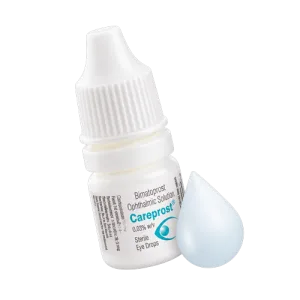
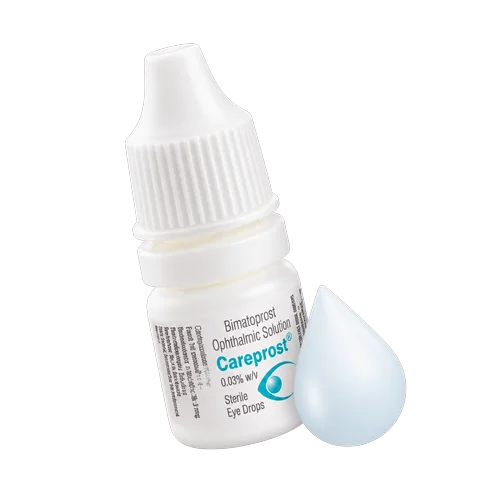
Careprost contains bimatoprost in an ophthalmic solution supplied in a bottle. Bimatoprost belongs to the prostamide group and is closely related to ocular prostaglandin analogues. Its established ophthalmic action involves changes in aqueous-humour drainage, which can reduce pressure inside the eye. Its secondary follicular effect may increase eyelash length, thickness, and pigmentation [1].
The solution is applied topically around the eye. The eyelash-growth effect develops gradually because each hair follicle moves through active growth, transition, and resting phases at its own pace.
Active Ingredient Profile
Bimatoprost is a synthetic molecule that resembles naturally occurring prostamide signalling compounds. In ophthalmology, it acts on tissues involved in fluid movement within the eye. Around the eyelid margin, the same class of signalling may influence the activity and duration of the eyelash follicle’s growth phase.
Directions for use
The amount and frequency of Careprost depend on the purpose of treatment and are agreed with a doctor or pharmacist. For eyelash use, the solution is applied to the upper eyelid margin, not directly into the eye.
- Remove contact lenses before application.
- Wash and dry the face, with eye makeup removed.
- Place one drop onto a sterile single-use applicator.
- Draw the applicator along the upper eyelid margin from the inner side towards the outer corner.
- Keep the lower eyelid and lower lash line free from the solution.
- Blot excess liquid from the skin without rubbing the eye.
- Use a separate sterile applicator for the other eye.
- Do not place the applicator tip against the eye, lashes, skin, or any other surface.
- Do not apply extra solution to compensate for a missed application.
- If a dose is missed, resume the usual schedule rather than applying twice.
Direct instillation into the conjunctival sac is used for pressure-lowering ophthalmic treatment when specifically prescribed. Eyelash application follows a different technique and should remain limited to the upper lash margin.
A small amount of overflow can irritate the surrounding skin and may contribute to unwanted pigmentation. Wipe excess solution from the upper cheek and eyelid area with a clean tissue.
Comparison
Careprost and Latisse contain bimatoprost as the relevant active substance, but products can differ in formulation details, approved indication, preservative system, and regulatory documentation. The name of the product does not establish that two bottles are interchangeable for every use.
| Product or approach | Active substance and main clinical role | Practical distinction |
|---|---|---|
| Careprost | Bimatoprost ophthalmic solution; use depends on the prescribed purpose | Bottle-based ophthalmic administration |
| Latisse | Bimatoprost formulation associated with eyelash hypotrichosis treatment | Developed and labelled for eyelash enhancement |
| Other ocular prostaglandin analogues | Different active substances used mainly for intraocular pressure control | They should not be treated as substitutes for bimatoprost eyelash treatment |
Bimatoprost is not interchangeable with latanoprost, travoprost, or tafluprost simply because all belong to the broader ocular prostaglandin family. Their molecular structures, dosing instructions, approved indications, and adverse-effect profiles differ.
The most useful comparison is the active substance and intended use. A clinician may select a bimatoprost product for eyelash hypotrichosis, intraocular-pressure management, or another ophthalmic purpose, with administration adjusted accordingly.
Common mistakes
Several practical errors reduce tolerability or make the response difficult to judge:
- applying extra drops because the first application produced no visible change;
- brushing the solution onto the lower eyelid;
- using the same applicator for both eyes;
- touching the bottle tip to the lashes;
- applying the solution over contact lenses;
- continuing despite eye pain, marked redness, or visual disturbance;
- using several prostaglandin-related eye products without review;
- judging the result after only a few days;
- allowing excess liquid to remain on the cheek or eyelid;
- stopping prescribed pressure-lowering treatment because the lashes appear improved.
One overlooked mistake is changing application time every day. A consistent routine makes it easier to identify irritation, missed applications, and gradual changes in lash density.
Another is using cosmetic mascara immediately after application. Allow the solution to dry first, since wet product can spread beyond the intended margin and increase skin exposure.
What doctors say
In clinical practice, doctors usually separate two questions: why bimatoprost is being used and where it is being applied. Treatment for raised intraocular pressure involves ophthalmic dosing into the eye. Eyelash enhancement involves application to the upper eyelid margin. Confusing these techniques can increase irritation or reduce the intended result. A consistent technique helps limit avoidable exposure.
Eye specialists also assess the condition of the ocular surface before recommending a prostamide analogue. Persistent redness, uncontrolled blepharitis, severe dry eye, or active inflammation can make treatment uncomfortable and may require management first.
A realistic expectation is gradual change rather than an immediate cosmetic transformation. Follicle cycles vary, and the response can be uneven. Some people see a visible difference after several weeks, while others need longer observation before deciding whether the benefit is meaningful.
Doctors also discuss continuation. Eyelash enhancement generally depends on continued exposure to bimatoprost; after treatment ends, newly produced lashes gradually return towards their previous growth pattern as follicles complete their natural cycles. The eye-pressure indication has different treatment goals and should not be stopped abruptly without a clinical plan.
What customers often ask
How does Careprost differ from other prostaglandin eye treatments?
Careprost contains bimatoprost, while other ocular prostaglandin treatments may contain latanoprost, travoprost, or tafluprost. These substances share a broad pharmacological family but are not identical in molecular action, approved uses, or eyelash effects. The FDA and EMA describe bimatoprost primarily within ophthalmic pressure management and eyelash-growth treatment contexts, with product-specific instructions applying to each formulation [4]. The FDA's 2008 LATISSE prescribing information provides product-specific eyelash-use instructions. A doctor selects the active substance according to the eye condition and treatment objective.
When does the eyelash effect become noticeable?
Eyelash changes develop gradually because bimatoprost influences follicle cycling rather than coating the lashes with an instant cosmetic film. Some users notice early changes after several weeks, while a fuller result can take longer as more follicles enter or remain in the growth phase. Clinical information reviewed by the FDA describes continued use as necessary to maintain the eyelash effect. The FDA's 2008 LATISSE prescribing information supports assessing the response over a clinically reasonable period rather than after a few applications.
Which eye condition rules out Careprost?
Active intraocular inflammation, such as uveitis or iritis, is a condition that requires clinical assessment before bimatoprost treatment. A history of macular oedema, complicated eye surgery, or significant retinal disease also needs specialist review. Acute eye pain or sudden visual loss should be assessed urgently rather than treated with additional drops. The EMA's 2022 product information for bimatoprost describes these ophthalmic precautions and the need for condition-specific monitoring.
What should be discussed with a doctor before starting Careprost?
Discuss previous eye surgery, glaucoma, retinal disease, uveitis, macular oedema, chronic dry eye, contact-lens use, and any current eye drops. Mention pregnancy or breastfeeding, previous reactions to prostaglandin-related treatments, and unexplained changes in eye colour. The doctor may need to establish whether the intended purpose is eyelash enhancement or intraocular-pressure control, because the application method differs. WHO eye-care guidance from 2022 supports reviewing existing ocular disease and treatment before adding another topical eye medicine.
Can Careprost be combined with other eye medicines or supplements?
Careprost should not be combined with another prostaglandin analogue or pressure-lowering eye treatment without a coordinated plan. Additive redness, irritation, pigmentation, or pressure changes may occur when related ophthalmic medicines are used together. Supplements do not automatically make the combination safe, especially if they affect bleeding, blood pressure, or immune function. Provide the full list of prescription medicines, over-the-counter products, and supplements to the clinician managing the eye treatment. The FDA's 2023 LUMIGAN prescribing information also supports reviewing concurrent ophthalmic treatment with a clinician.
Do you offer anonymous delivery?
Your order will be securely packed and shipped within 24 hours. This is exactly what your package will look like (images of an actual item sent). It has the size and look of a regular private letter (24x11x0.7 cm) and its contents cannot be seen.
Comparison
How Buyers Rate Careprost
I saw some extra length, although it took longer than I expected. I had mild irritation at the beginning and discussed it with my doctor before continuing, so the experience was useful but not completely effortless.
My lashes became fuller enough that I needed less eye makeup. The improvement was easy to see in photographs, and I was pleased with the gradual result.
Sources
- U.S. Food and Drug Administration (2023). LUMIGAN (bimatoprost ophthalmic solution) Prescribing Information
- U.S. Food and Drug Administration (2008). LATISSE (bimatoprost ophthalmic solution) Prescribing Information
- European Medicines Agency (2022). Summary of Product Characteristics (SmPC) — bimatoprost ophthalmic solution
- European Medicines Agency (2021). European public assessment report (EPAR) — bimatoprost ophthalmic solution