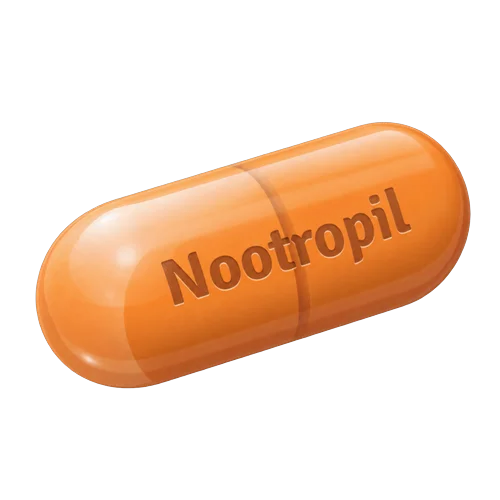
I used Nootropil as part of treatment for jerking movements. Writing and using cutlery felt easier, and I was pleased with the practical difference during workdays.
Nootropil
Piracetam may influence neuronal membranes and brain signalling without acting as a conventional stimulant. It is intended for people receiving specialist neurological care, including treatment for cortical myoclonus, and its effects involve neuronal membrane function, neurotransmission, and blood rheology.
Overview
Piracetam, the active ingredient of Nootropil, is a nootropic medicine used in neurological care, including cortical myoclonus. Nootropil capsules are taken orally, with the amount selected for each person rather than one fixed dose.
Pharmacological classification
Piracetam belongs to the racetam group of nootropic medicines. The term “cognitive enhancer” is broader than “nootropic” and includes substances with different mechanisms, evidence levels, and risks. Piracetam is used in specific neurological situations rather than as a general replacement for sleep, rehabilitation, or treatment of every concentration problem.
It does not work by producing the typical alerting effect associated with amphetamine-type stimulants. Some people may still experience nervousness, agitation, sleep disturbance, or headache, especially when treatment is unsuitable or the dose is poorly tolerated.
Therapeutic indications
Nootropil is used mainly in neurological treatment. Its established clinical role includes cortical myoclonus, a condition in which abnormal electrical activity in the cerebral cortex causes brief, involuntary muscle jerks.
Cortical myoclonus management
Myoclonus may appear as sudden twitching or shock-like movements affecting the arms, legs, face, or trunk. Cortical myoclonus originates from the brain’s cortical motor areas rather than from a simple muscle problem. The movements can interfere with walking, writing, eating, speech, or sleep.
Piracetam may be prescribed as part of a specialist treatment plan. Improvement is assessed through the frequency, severity, and functional impact of the jerks. The medicine does not remove every possible cause of myoclonus, and a neurological assessment remains essential when symptoms are new, rapidly worsening, or associated with weakness, confusion, or loss of consciousness.
The word “neuroprotection” is sometimes used when discussing piracetam, yet it should not be interpreted as a guarantee that the medicine prevents dementia, stroke, or progressive brain disease. The strongest product-specific use is the management of suitable neurological disorders, with the treatment decision based on clinical assessment.
Mechanism of action
Piracetam has a different pharmacological profile from conventional central nervous system stimulants and from medicines that work mainly through serotonin reuptake inhibition. Research describes effects on neuronal membrane fluidity, synaptic signalling, and the movement of information between nerve cells.
The medicine may alter the function of membrane proteins and ion channels involved in neuronal communication. It also has recognised effects on red-cell deformability and platelet-related processes, which help explain why bleeding history and anticoagulant treatment require attention. The exact relationship between these biological effects and symptom improvement can vary between conditions.
Evidence for broad cognitive enhancement in healthy adults is less consistent than the clinical rationale for specialist neurological use. A person who feels tired from sleep loss, depression, anaemia, thyroid disease, or excessive workload may not gain a meaningful benefit from piracetam. Treating the underlying problem is more appropriate than using a nootropic as a general energy product.
A review of piracetam pharmacology indexed in PubMed describes its membrane and neurotransmission effects without classifying it as a conventional stimulant [2].
Reasons not to use it
Nootropil is not suitable for everyone. Piracetam must be avoided in people with a known allergy to piracetam or any component of the formulation. It is also contraindicated in severe kidney disease when the medicine cannot be cleared safely, and in people with Huntington’s disease or Huntington’s chorea.
Older adults often need closer monitoring because kidney function can decline without obvious symptoms. A creatinine-based kidney assessment may be needed before treatment and during longer courses. The renal contraindication and bleeding-related cautions are described in the official European product information [3].
Pregnancy and breastfeeding require an individual medical decision. Piracetam crosses biological barriers, and treatment should continue only when the prescriber has considered the expected benefit and possible risk.
When this is not for you
This medicine is not for you if
- You have had an allergic reaction to piracetam or one of the capsule ingredients.
- You have severe renal impairment and have not received a specialist dosing assessment.
- You have Huntington’s disease or Huntington’s chorea.
- You have active serious bleeding or a condition that makes bleeding difficult to control.
- You are undergoing an operation and the clinical team has not reviewed the treatment.
- You have a history of haemorrhagic stroke that has not been discussed with the prescriber.
Unwanted effects
Reported adverse effects with piracetam include nervousness, agitation, anxiety, sleep disturbance, headache, dizziness, gastrointestinal discomfort, diarrhoea, nausea, and weight gain. Some people develop drowsiness or reduced concentration instead of greater alertness. The frequency and severity depend on the person, the indication, kidney clearance, and the prescribed amount.
Possible reactions include:
- Headache or dizziness.
- Nervousness, irritability, or agitation.
- Insomnia or unusual sleepiness.
- Nausea, abdominal discomfort, or diarrhoea.
- Increased body weight.
- Skin rash, itching, or swelling caused by hypersensitivity.
- Worsening of bleeding tendency in susceptible patients.
Seek urgent medical attention for facial or throat swelling, breathing difficulty, extensive rash, uncontrolled bleeding, sudden confusion, or a severe change in neurological symptoms. A mild stomach upset may improve when the medicine is taken with food, but the prescribed schedule should remain unchanged unless the clinician modifies it.
Dose timing can affect how symptoms are interpreted. new insomnia may be mistaken for a sign that the medicine is improving alertness. In reality, persistent sleep loss can worsen concentration and myoclonus, so the timing of each dose deserves review.
Another detail concerns weight. Weight gain is documented as an adverse reaction, yet it is not proof that the medicine is improving cognition or muscle control. Record a sustained change and report it rather than compensating by changing the dose independently.
The UK product information lists nervousness, hyperkinesia, weight increase, somnolence, depression, and gastrointestinal symptoms among reported adverse reactions [4].

Formulation
Nootropil contains piracetam, a synthetic nootropic compound used in the management of cortical myoclonus. A nootropic is a medicine that affects cognitive or neuronal function through pharmacological activity; it is not the same as a caffeine-like stimulant. Piracetam’s effects involve neuronal membrane function, neurotransmission, and blood rheology rather than direct cardiovascular stimulation.
The therapeutic response depends on the condition being treated, kidney function, age, and the total daily amount prescribed. Nootropil capsules are intended for oral use. The amount per intake is selected individually rather than being one fixed number for every person. The official product information describes piracetam’s pharmacology, clinical uses, contraindications, and interaction cautions [1].
Pharmacological classification
Piracetam belongs to the racetam group of nootropic medicines. The term “cognitive enhancer” is broader than “nootropic” and includes substances with different mechanisms, evidence levels, and risks. Piracetam is used in specific neurological situations rather than as a general replacement for sleep, rehabilitation, or treatment of every concentration problem.
It does not work by producing the typical alerting effect associated with amphetamine-type stimulants. Some people may still experience nervousness, agitation, sleep disturbance, or headache, especially when treatment is unsuitable or the dose is poorly tolerated.
Directions for use
Nootropil is supplied on this page as oral capsules. The capsule should be swallowed with liquid and used according to the prescribed schedule. The correct amount depends on the patient and the indication, so a single universal tablet-style instruction would be misleading.
The following principles apply to treatment planning:
- The dose is selected individually.
- The medicine is taken by mouth.
- Doses are usually divided across the day when the prescribed regimen requires repeated administration.
- A missed dose should not be replaced with an unplanned double dose.
- Treatment should not be stopped abruptly when it is being used for cortical myoclonus unless the prescriber gives that instruction.
- Kidney function may require dose adjustment.
- The capsule should not be opened, crushed, or chewed unless a prescriber or pharmacist has confirmed that this is suitable for the specific product.
Nootropil oral solution and other piracetam presentations exist in some healthcare systems, but the product form described here is capsules. A liquid concentration cannot be substituted for a capsule amount without a deliberate calculation by a healthcare professional.
Comparison
A comparison by mechanism is more useful than a comparison by marketing name. Piracetam has a different clinical profile from stimulant medicines and from other racetam compounds.
| Approach | Main pharmacological focus | Typical clinical limitation |
|---|---|---|
| Piracetam | Neuronal membrane and neurotransmission effects | Evidence and use are condition-specific |
| Aniracetam | Racetam compound with different receptor and membrane activity | Not an interchangeable substitute for piracetam |
| Conventional stimulant | Increased alerting and activating neurotransmission | Can cause insomnia, anxiety, tachycardia, or dependence-related concerns |
Piracetam is not automatically stronger because it belongs to an older nootropic group. Aniracetam should not be substituted on a milligram-for-milligram basis, and a clinician should not assume that one racetam has the same indication as another.
For cortical myoclonus, the relevant question is whether the treatment reduces involuntary movements and improves function. For nonspecific fatigue or poor concentration, the cause of the symptom matters more than the label “cognitive enhancer”.
Common mistakes
Several avoidable errors can reduce the value of treatment or increase risk:
- Taking a missed dose together with the next dose.
- Changing the amount because symptoms fluctuate from day to day.
- Stopping suddenly during treatment for cortical myoclonus.
- Ignoring new bruising while taking an anticoagulant or low-dose aspirin.
- Treating insomnia as a desirable stimulant effect.
- Forgetting to mention non-prescription medicines.
- Assuming that an oral solution and a capsule can be exchanged without recalculating the amount.
- Continuing treatment without kidney-function review in older age.
- Expecting piracetam to correct concentration problems caused by sleep deprivation, depression, thyroid disease, or anaemia.
What doctors say
In clinical practice, a neurologist usually sets a measurable treatment target before starting piracetam. The target may be fewer jerks, improved handwriting, safer walking, better sleep, or greater independence with daily tasks.
Doctors also pay close attention to kidney function. A person can feel well while having reduced renal clearance, especially in later life. The selected amount may need adjustment even when the capsule appears easy to tolerate.
A second clinical point concerns expectations. Piracetam is not a universal treatment for forgetfulness, stress, or ordinary tiredness. If there is no meaningful improvement after a suitable assessment period, the diagnosis, treatment goal, adherence, and alternative causes should be reviewed.
Neurologists also ask about bleeding history, anticoagulants, aspirin, thyroid treatment, and upcoming surgery. These questions are practical safeguards, not routine paperwork.
What customers often ask
Can Nootropil affect driving, concentration, or work with machinery?
Piracetam may cause sleepiness, dizziness, nervousness, or reduced concentration in some people, even though it is classified as a nootropic rather than a conventional stimulant. A person should not drive or operate machinery until they know how the capsules affect them. The MHRA’s 2023 general medicine-safety principles support avoiding safety-critical activity when a medicine causes impaired alertness or coordination [5]. Alcohol can worsen drowsiness and judgement. The NHS also published related patient advice in 2023.
How soon might the effect of Nootropil become noticeable?
The timing depends on the condition, the treatment plan, symptom severity, kidney function, and the individual response. A benefit may be assessed through changes in jerking frequency or daily function rather than through a sudden feeling of mental stimulation. Do not increase the amount because improvement is not immediate. Clinical review is more useful than judging the medicine after one dose. A 1991 PubMed review describes assessment by clinical response rather than a guaranteed immediate effect.
Which concrete condition rules out Nootropil?
Huntington’s disease, also called Huntington’s chorea, is a specific contraindication to piracetam. Severe kidney impairment can also rule out treatment when safe clearance is not possible. An allergy to piracetam or a capsule ingredient is another clear reason to avoid it. These restrictions are reflected in the European Medicines Agency’s 2023 product-safety framework and should be checked before treatment begins.
Can older adults use Nootropil?
Older adults may use piracetam when a clinician has confirmed an appropriate indication and reviewed kidney function, as described in the 2024 Electronic Medicines Compendium information. Renal clearance often falls with age, so the individually selected amount may be lower than expected. Older patients also have a greater chance of taking warfarin, acenocoumarol, aspirin, or several other medicines at once. A medication review should include falls, bruising, sleep changes, and confusion.
What should be discussed with a doctor before starting Nootropil?
Discuss the reason for treatment, kidney disease, previous bleeding, Huntington’s disease, allergies, pregnancy or breastfeeding, and every medicine taken regularly or occasionally. Mention warfarin, acenocoumarol, low-dose aspirin, thyroid extract, and thyroxine specifically. Upcoming surgery should also be disclosed. The 2024 Electronic Medicines Compendium product information also advises reviewing relevant precautions before treatment. The doctor can then decide whether piracetam is suitable, select the individual amount, and arrange any needed monitoring.
Do you offer anonymous delivery?
Your order will be securely packed and shipped within 24 hours. This is exactly what your package will look like (images of an actual item sent). It has the size and look of a regular private letter (24x11x0.7 cm) and its contents cannot be seen.
Comparison
How Buyers Rate Nootropil
I did not notice a useful improvement in concentration, and I became more restless at night. I stopped after discussing the problem with my doctor rather than changing the amount myself.
The main benefit was fewer interruptions from sudden movements while walking around the house. I kept taking it at the same times and found the routine manageable.
My hand jerks became less disruptive over time, especially when I was eating or typing. The improvement was gradual, but it made ordinary tasks less frustrating.
Sources
- Electronic Medicines Compendium (2024). Nootropil 800 mg film-coated tablets — Summary of Product Characteristics.
- PubMed (1991). Piracetam: a review of pharmacological properties and clinical uses.
- European Medicines Agency (2023). Guideline on the clinical investigation of medicinal products for the treatment of dementia.
- Electronic Medicines Compendium (2024). Nootropil — Summary of Product Characteristics: Undesirable effects.
- Medicines and Healthcare products Regulatory Agency (2023). Driving and medicines: advice for patients.