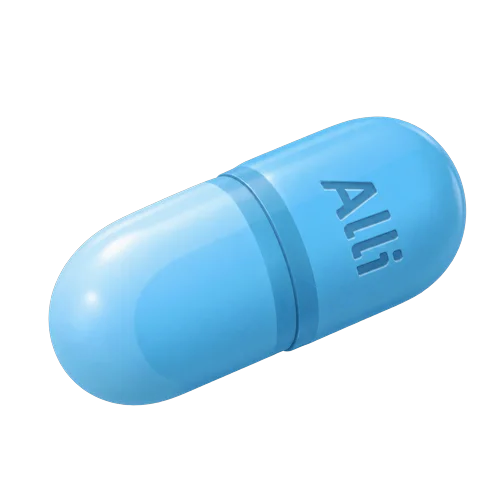
I took one capsule with meals for several weeks alongside smaller evening meals. My weight began moving in the direction I wanted, and I found the routine straightforward once I stopped making lunch and dinner too fatty.
Alli
Alli capsules are taken by mouth with meals to support weight management in adults with obesity. Its active ingredient, orlistat, works inside the digestive tract by reducing the absorption of part of the fat in food.
Overview
Alli contains orlistat, a gastrointestinal lipase inhibitor used as part of a weight-management programme for adults with obesity. It acts locally in the gut rather than changing appetite through the central nervous system. The treatment is intended to accompany a reduced-calorie, nutritionally balanced diet that distributes fat across meals [1].
Active Ingredient Profile
The active ingredient is orlistat. Its pharmacological class is gastrointestinal lipase inhibitor.
The product is supplied as capsules. The dose is decided individually, taking age, other medicines and health conditions into account.
Therapeutic indications
Orlistat is prescribed or supplied for selected adults whose weight and health profile make pharmacological support appropriate. It does not remove all dietary fat. Instead, it prevents some triglycerides from being broken down into absorbable fatty acids and monoglycerides.
The practical consequence is simple: meals with more fat are more likely to cause digestive side effects. Alli is therefore most manageable when meals contain modest, evenly distributed amounts of fat.
Mechanism of action
Orlistat blocks gastric and pancreatic lipases within the lumen of the stomach and small intestine. These enzymes normally split dietary triglycerides into smaller molecules that can cross the intestinal wall.
When orlistat inhibits the enzymes, part of the ingested fat remains undigested and passes through the bowel. The body therefore absorbs fewer calories from that fat fraction. The medicine does not directly burn stored body fat, raise metabolism or suppress the appetite through the brain.
This local mechanism explains several features of treatment:
- The action takes place mainly inside the gastrointestinal tract.
- Only a small amount of unchanged orlistat reaches systemic circulation.
- The effect relates to the fat content of the meal.
- Undigested fat can produce oily spotting, loose stools, faecal urgency or increased bowel frequency.
- Fat-soluble vitamins may be absorbed less efficiently during treatment.
The European Medicines Agency describes orlistat as an inhibitor of gastrointestinal lipases, with its weight-management effect linked to reduced dietary-fat absorption [2]. The benefit develops through repeated use alongside dietary changes, not through a single capsule.
Reasons not to use it
Alli must not be used by people with chronic malabsorption syndrome or cholestasis, because these conditions can alter fat digestion, bile flow and the handling of fat-soluble nutrients.
Clinical restrictions include:
- Chronic malabsorption syndrome.
- Cholestasis.
- Serious allergic reaction to orlistat or an excipient in the capsule.
- Concomitant ciclosporin use without a specialist-managed treatment plan.
- A medical condition requiring close control of anticoagulation when monitoring cannot be obtained.
- Pregnancy unless a specialist has specifically directed treatment.
- Breastfeeding without a clear clinical reason and professional review.
- Symptoms suggesting an untreated gastrointestinal or hepatobiliary disorder.
When this is not for you
This medication is not for you if you:
- Have chronic malabsorption syndrome.
- Have cholestasis.
- Have had a serious allergic reaction to orlistat or an excipient in the capsule.
- Are taking ciclosporin without a specialist-managed treatment plan.
- Have a medical condition requiring close control of anticoagulation and are unable to obtain monitoring.
- Are pregnant unless a specialist has specifically directed treatment.
- Are breastfeeding without a clear clinical reason and professional review.
- Have symptoms suggesting an untreated gastrointestinal or hepatobiliary disorder.
People with a history of kidney stones, pancreatitis, liver disease, gallbladder disease or eating disorders need an individual assessment before treatment. These conditions do not all represent absolute contraindications, but they can change the balance of benefit and risk.
A person with persistent severe abdominal pain, jaundice, dark urine or pale stools needs prompt medical assessment rather than continued self-management.
Unwanted effects
The most characteristic adverse effects are gastrointestinal. They arise because undigested fat passes into the bowel.
Common effects include:
- Oily or fatty stools.
- Oily spotting.
- Faecal urgency.
- Loose stools or diarrhoea.
- Increased bowel frequency.
- Abdominal cramps or discomfort.
- Flatulence with discharge.
These effects are often more pronounced after meals high in fat. They may improve when dietary fat is reduced and spread more evenly through the day. Persistent or severe diarrhoea can cause dehydration and requires attention.
Less common but clinically significant problems include allergic reactions, kidney complications, liver injury and pancreatitis. Symptoms requiring urgent assessment include facial or throat swelling, breathing difficulty, severe continuous abdominal pain, yellowing of the skin or eyes, dark urine, or markedly reduced urine output.
One practical issue is often underestimated: bowel urgency can interfere with commuting, work, exercise and social plans during the first weeks. Planning access to a toilet and keeping meals lower in fat can make treatment easier to manage.
Another detail matters for long-term use. Reduced absorption of vitamins A, D, E and K can contribute to deficiency risk, especially when the diet is already restrictive or nutritional intake is poor.
Formulation
The active ingredient is orlistat. Its pharmacological class is gastrointestinal lipase inhibitor.
The product is supplied as capsules.
Directions for use
Alli capsules are taken orally with meals. Administration should match the prescribed or authorised dosing plan, because age, concurrent medicines, medical conditions and treatment goals affect the appropriate regimen.
Practical administration points include:
- Take the capsule with a main meal or shortly after it.
- A meal containing no fat does not provide the same reason for a dose.
- Do not compensate for a missed dose by taking extra capsules later.
- Keep meals nutritionally balanced and avoid placing most daily fat in one meal.
- Discuss the timing of vitamin supplementation with a prescriber or pharmacist because orlistat can reduce absorption of vitamins A, D, E and K.
- Continue the dietary plan used with treatment rather than treating the capsule as permission to eat unrestricted high-fat meals.
The treatment period should be reviewed if weight loss is not clinically meaningful or if gastrointestinal effects remain difficult to manage. NICE places lifestyle measures at the centre of obesity treatment and treats medicines as part of a wider weight-management plan [3].
Capsules should be swallowed as directed. Do not open them to mix into food unless a prescriber has specifically provided that instruction.
Comparison
Orlistat treatment can be supplied in a lower-strength non-prescription approach or a higher-strength prescription approach. Both forms use the same local mechanism, but their regulatory status, supervision and dosing differ.
| Treatment approach | Main distinction | Clinical emphasis |
|---|---|---|
| Lower-strength orlistat capsules | Non-prescription weight-management option in eligible adults | Diet quality, suitability screening and tolerability |
| Higher-strength prescription orlistat | Prescriber-led treatment for selected patients | Medical review, response assessment and interaction monitoring |
| Lifestyle treatment without orlistat | Nutrition, activity and behavioural support | Sustainable calorie reduction and long-term weight control |
The lower-strength approach can be useful when the person meets the relevant eligibility criteria and can follow a reduced-fat diet. Prescription treatment may be selected when obesity-related disease, complex medicines or limited response requires closer clinical supervision.
Orlistat is not interchangeable across strengths without professional direction. A larger amount does not automatically mean proportionally greater weight loss, while gastrointestinal adverse effects may become more troublesome when dietary fat remains high.
Common mistakes
Several avoidable errors make treatment harder to tolerate.
Treating the capsule as a free pass for high-fat meals
This is the most frequent practical problem. Large amounts of fried food, creamy sauces or fatty takeaway meals can produce urgent oily diarrhoea because more undigested fat reaches the colon.
Taking extra capsules after a missed dose
A missed dose should not be replaced with a double dose. Extra orlistat does not reliably restore the missed effect and may increase gastrointestinal symptoms.
Forgetting about vitamins
Long-term treatment can affect the absorption of fat-soluble vitamins. Vitamin supplementation may be needed for some patients, but timing should be planned so it does not simply pass through with the medicine.
Ignoring other medicines
Warfarin, ciclosporin, levothyroxine, antiepileptic medicines and diabetes treatments can require specific management. Informal spacing of doses is not enough for every interaction.
Continuing despite warning symptoms
Severe abdominal pain, jaundice, serious allergic symptoms or marked dehydration need medical assessment. Continuing capsules while waiting for symptoms to settle can delay recognition of a serious problem.
What doctors say
In clinical practice, doctors usually frame Alli as a tool that reinforces dietary change rather than a stand-alone weight-loss solution. The medicine works best when the patient understands the link between meal fat and bowel effects. Follow-up helps assess weight change and tolerability. Clinicians can adjust related medicines when weight or dietary intake changes. This review also provides an opportunity to reassess whether continued treatment remains suitable.
A prescriber will usually review:
- Body mass index and weight-related health risks.
- Previous weight-management attempts.
- Diet pattern and typical fat intake.
- Current medicines, especially warfarin, ciclosporin and thyroid treatment.
- Kidney, liver, gallbladder and gastrointestinal history.
- Pregnancy or breastfeeding status.
- The amount of weight lost during follow-up.
The most useful expectation is gradual progress. Orlistat does not create an immediate visual change, and early bowel effects do not prove that more weight will be lost. A person who cannot maintain the accompanying dietary plan may experience inconvenience without gaining a worthwhile benefit.
Weight reduction can also alter blood glucose, blood pressure and anticoagulation control. Doctors may therefore adjust other medicines during follow-up rather than leaving the full treatment regimen unchanged.
What customers often ask
What happens after stopping Alli, and is tapering needed?
Orlistat does not normally require a gradual taper because it acts locally in the digestive tract and does not produce a dependence syndrome. After stopping, the reduction in dietary-fat absorption ends, so weight may return if calorie intake rises or the accompanying lifestyle plan is abandoned. NICE guidance published in 2014 and maintained through later updates supports continued behavioural and dietary measures after medicine changes. A planned review can help preserve progress and identify changes needed in diabetes, blood-pressure or anticoagulant treatment.
Which symptoms mean that Alli should be stopped and medical help sought urgently?
Stop taking further capsules and seek urgent medical assessment for facial swelling, throat tightness, breathing difficulty, severe persistent abdominal pain, fainting or signs of severe dehydration. Yellow skin or eyes, dark urine, pale stools or unusual extreme tiredness may indicate liver problems and require prompt review. Unexpected bleeding or extensive bruising is urgent for someone taking warfarin. MHRA safety communications from 2012 identify serious interaction and adverse-effect symptoms as reasons for rapid clinical action, not symptoms to manage by simply changing the next dose.
Do you offer anonymous delivery?
Your order will be securely packed and shipped within 24 hours. This is exactly what your package will look like (images of an actual item sent). It has the size and look of a regular private letter (24x11x0.7 cm) and its contents cannot be seen.
Comparison
How Buyers Rate Alli
I took one capsule with meals for several weeks and noticed a clear difference after keeping my meals more consistent. The capsule fitted easily into my workday, and the gradual weight change was more useful to me than trying another short, extreme diet.
I took one capsule with meals for several weeks, but Alli did not suit me. I had repeated urgency and oily stools after meals, and the weight change was limited. I stopped and discussed the symptoms with my doctor rather than continuing through the problem.
Sources
- European Medicines Agency (2013). European public assessment report for orlistat (Alli).
- European Medicines Agency (2013). Summary of Product Characteristics for orlistat.
- National Institute for Health and Care Excellence (2014). Obesity: identification, assessment and management (NG7).