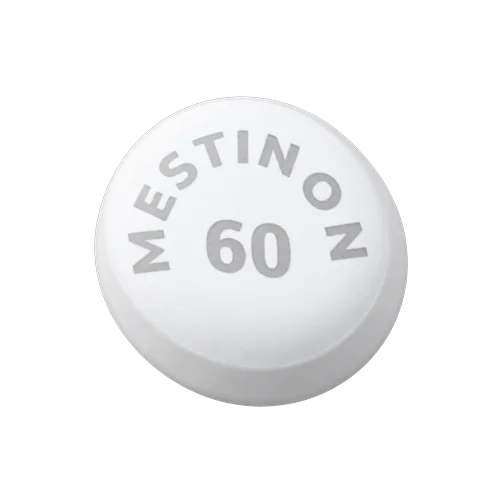
I used the 60 mg tablets for several weeks and noticed that climbing the stairs became less tiring. My speech also stayed clearer later in the day, which made ordinary conversations easier.
Mestinon
Mestinon is an oral product containing pyridostigmine bromide for people with myasthenia gravis. It helps improve nerve-to-muscle communication, with the dose decided individually according to age, other medicines, and health conditions.
Overview
Mestinon contains pyridostigmine bromide, an acetylcholinesterase inhibitor used to improve skeletal-muscle strength in people with myasthenia gravis. The tablet supports muscle function by increasing the amount of acetylcholine available at the neuromuscular junction, where nerves communicate with muscles.
Myasthenia gravis is an autoimmune condition that interferes with communication between nerves and voluntary muscles. Weakness may affect the eyelids, facial muscles, speech, swallowing, arms, legs, or breathing muscles. Mestinon improves signal transmission but does not remove the underlying autoimmune cause.
The Medicines and Healthcare products Regulatory Agency (MHRA) recognises pyridostigmine as an established treatment for symptomatic management of myasthenia gravis [1].
Clinical indication in myasthenia gravis
Mestinon is used when reduced neuromuscular transmission causes fluctuating weakness. Symptoms often become more noticeable after repeated muscle use and may ease after rest. Treatment aims to improve daily function, such as walking, speaking, chewing, swallowing, or keeping the eyes open.
The response differs between patients. Some need doses spread across the day because the benefit wears off between doses. Others require a modified-release formulation or additional treatment selected by a neurology team. The prescribed regimen depends on symptom pattern, age, kidney function, other medicines, and the severity of weakness.
Therapeutic indications
Mestinon is used when reduced neuromuscular transmission causes fluctuating weakness. Symptoms often become more noticeable after repeated muscle use and may ease after rest. Treatment aims to improve daily function, such as walking, speaking, chewing, swallowing, or keeping the eyes open.
The Medicines and Healthcare products Regulatory Agency (MHRA) recognises pyridostigmine as an established treatment for symptomatic management of myasthenia gravis [1].
Mechanism of action
A motor nerve normally releases acetylcholine into the small gap between the nerve ending and the muscle membrane. Acetylcholine binds to receptors on the muscle, creating the electrical change that triggers contraction. Acetylcholinesterase then breaks down acetylcholine, ending the signal.
In myasthenia gravis, antibodies reduce the number or function of acetylcholine receptors. The normal nerve signal may therefore be too weak to produce reliable muscle contraction. Pyridostigmine reversibly inhibits acetylcholinesterase, so acetylcholine remains available for longer and has more opportunity to activate the remaining receptors.
This mechanism explains why Mestinon can improve strength without acting as a stimulant. It also explains why excessive dosing may produce too much cholinergic activity, including sweating, abdominal cramps, diarrhoea, excess saliva, slow heart rate, or increased muscle weakness.
The World Health Organization classifies pyridostigmine within the nervous-system medicines used for neuromuscular disorders [2]. The medicine improves transmission; it does not suppress the antibodies responsible for the disease.
Reasons not to use it
Mestinon is not suitable for everyone. It is NOT for you if you have a mechanical blockage of the intestine or urinary tract, because increased smooth-muscle activity could worsen the obstruction.
Extra caution is required with:
- Asthma or chronic respiratory disease
- Slow heart rate, conduction problems, or fainting
- Peptic ulcer disease
- Epilepsy
- Overactive thyroid
- Kidney impairment
- Previous severe reaction to pyridostigmine or tablet ingredients
Pharmacological drug interactions
Mestinon can interact with medicines that affect neuromuscular transmission or cholinergic activity.
- Suxamethonium: pyridostigmine may alter the response to this depolarising neuromuscular blocker during anaesthesia.
- Mecamylamine: combined effects on autonomic nerve transmission may produce unpredictable responses.
- Guanethidine: the combination may intensify changes in autonomic function or blood pressure.
- Other cholinesterase inhibitors: combined use can increase cholinergic adverse effects.
- Antimuscarinic medicines: they may reduce some secretory or intestinal effects while creating a less predictable clinical picture.
- Aminoglycoside antibiotics and other medicines affecting neuromuscular transmission: these may worsen weakness in susceptible patients.
Tell the anaesthetist about pyridostigmine before surgery. The perioperative plan may require adjustment because neuromuscular-blocking medicines can interact with the transmission pathway that Mestinon is intended to support.
Pregnancy and breastfeeding require an individual risk–benefit assessment. Myasthenia gravis itself can change during pregnancy, and treatment decisions should account for maternal muscle strength, respiratory function, and the newborn’s condition.
When this is not for you
Mestinon may not be suitable if you have a blockage in your intestine or urinary tract. Speak with a doctor before taking it if you have asthma, breathing disease, a slow heartbeat, fainting, stomach ulcers, epilepsy, an overactive thyroid, kidney problems, or a previous severe reaction to pyridostigmine or its ingredients.
Unwanted effects
The most common unwanted effects result from increased cholinergic activity. They may involve the digestive system, secretory glands, heart, or muscles.
Possible effects include:
- Abdominal cramps or stomach discomfort
- Diarrhoea, nausea, or vomiting
- Increased saliva or tear production
- Sweating
- Urgent need to pass urine
- Blurred vision or smaller pupils
- Muscle twitching or cramps
- Slow pulse, dizziness, or faintness
These effects may indicate that the total cholinergic effect is too strong, especially when several symptoms appear together. Muscle weakness can also worsen with excessive treatment, making it difficult to distinguish a dose-related problem from progression of myasthenia gravis.
A serious reaction requires urgent medical attention. Seek emergency help for severe breathlessness, inability to swallow saliva, rapidly worsening weakness, fainting, a very slow heartbeat, or new severe bronchial secretions. Breathing weakness in myasthenia gravis can progress quickly.
One practical detail is easy to miss: diarrhoea and sweating may appear before a patient realises that the medicine is affecting more than muscle strength. Another is that abdominal cramping can be mistaken for an unrelated digestive illness when it starts soon after a dosing change.
Formulation
The active ingredient in Mestinon is pyridostigmine bromide. The dose is decided individually, taking age, other medicines, and health conditions into account, and the product is supplied as oral tablets.
| Pharmaceutical detail | Mestinon |
|---|---|
| Active ingredient | Pyridostigmine bromide |
| Drug class | Acetylcholinesterase inhibitor |
Directions for use
Mestinon tablets are taken orally. The dose is decided individually, taking age, other medicines, and health conditions into account.
- Take each tablet at the prescribed time.
- Swallow the tablet with water.
- Keep the dosing intervals as consistent as possible.
- Take it with or without food according to the regimen that suits your prescription and tolerability.
- Do not take extra tablets to compensate for weakness unless the prescriber has given a specific plan.
- If a dose is missed, take it when remembered unless the next scheduled dose is near; do not double the next dose.
Some people need treatment during waking hours, while others need a dose before meals or at another time linked to predictable weakness. Timing is individual. A person with chewing or swallowing weakness may need reliable coverage before meals, while another may need coverage for movement later in the day.
Do not crush, split, or alter a tablet unless the prescribing clinician or dispensing pharmacist has confirmed that this is suitable for the specific formulation. Modified-release pyridostigmine products are managed differently from standard tablets.
The treatment period may be long term because myasthenia gravis is often chronic. The regimen can change when symptoms, kidney function, pregnancy, surgery, or other medicines change.
Comparison
Pyridostigmine and neostigmine are both acetylcholinesterase inhibitors, yet their clinical use differs. Pyridostigmine is commonly used for ongoing symptomatic management of myasthenia gravis. Neostigmine is also used in neuromuscular practice, including reversal of certain non-depolarising neuromuscular blocks under anaesthetic supervision.
| Medicine or approach | Typical clinical role |
|---|---|
| Pyridostigmine | Ongoing oral symptomatic treatment in myasthenia gravis |
| Neostigmine | Selected neuromuscular uses, often in supervised clinical settings |
Pyridostigmine is available as an oral tablet, making repeated outpatient dosing practical. Neostigmine is more often used when a rapid, closely monitored effect is required, such as after surgery. The choice depends on the clinical situation, route, onset required, duration, kidney function, and monitoring available.
Neither medicine replaces specialist assessment. The wrong balance can produce under-treatment, with continuing weakness, or excessive cholinergic activity, which can also weaken muscles. The MHRA product information provides the prescribing framework for pyridostigmine tablets, while anaesthetic guidance governs the supervised use of neuromuscular reversal agents.
Common mistakes
Several avoidable problems can make Mestinon seem ineffective or poorly tolerated:
- Taking doses only after weakness becomes severe rather than following the planned schedule
- Doubling a missed dose
- Changing the interval without recording the result
- Assuming every episode of weakness means more pyridostigmine is needed
- Ignoring diarrhoea, sweating, cramps, or excess saliva after a dose increase
- Forgetting to mention Mestinon before anaesthesia
- Failing to report kidney disease
- Crushing or altering tablets without confirming that the formulation permits it
- Treating sudden swallowing or breathing difficulty as an ordinary late dose
One patient-level clue is timing. Weakness that appears predictably just before the next dose can suggest waning symptomatic coverage, while weakness accompanied by sweating, cramps, diarrhoea, and salivation may point towards excessive cholinergic activity.
Another practical mistake is comparing one day with another without considering infection or sleep. Myasthenia symptoms can fluctuate for reasons that a dose increase will not correct.
What doctors say
In clinical practice, neurologists usually assess Mestinon by function rather than by a single strength test. Useful outcomes include easier chewing, clearer speech, improved eyelid control, longer walking tolerance, or fewer periods of limb weakness.
A clinician will also look for the opposite pattern: sweating, diarrhoea, abdominal cramps, excess saliva, twitching, a slow pulse, or increasing weakness after doses. Those findings may suggest excessive cholinergic stimulation and should not be managed by simply taking more tablets.
Treatment works best when the daily schedule matches the patient’s predictable periods of weakness. A dosing diary can be more informative than a general statement that symptoms are variable. The MHRA describes the need for patient-specific assessment when medicines affecting neuromuscular transmission are used [3].
Doctors also review infections, sleep, thyroid disease, kidney function, pregnancy, upcoming surgery, and new prescriptions. Each can change muscle strength or alter how pyridostigmine is tolerated.
What customers often ask
Which condition rules out Mestinon completely?
Mechanical obstruction of the intestine or urinary tract is a clear contraindication because pyridostigmine can increase smooth-muscle activity. The MHRA product information identifies these obstructive conditions as reasons not to use the medicine. A history of asthma, slow heart rate, kidney disease, or ulcer disease does not automatically rule it out, but it requires careful prescribing. The prescriber also needs to know about previous allergic reactions to pyridostigmine or tablet ingredients. Dose changes should be guided by the treating clinician.
What is the best time of day to take Mestinon?
There is no single best time for every patient because the schedule is linked to the individual pattern of weakness. The dose may be timed around waking, meals, work, mobility, or predictable wearing-off periods. Guidance from the MHRA in 2023 supports individual adjustment of pyridostigmine dosing rather than one universal timetable. Taking doses at evenly planned times can make the response easier to assess and may reduce missed tablets.
Which symptoms mean stopping and seeking urgent medical help?
Severe breathing difficulty, inability to swallow, rapidly worsening weakness, fainting, or a very slow heartbeat requires urgent medical attention. Excessive salivation, sweating, diarrhoea, abdominal cramps, muscle twitching, and worsening weakness can signal excessive cholinergic activity and need prompt clinical assessment. The WHO ATC/DDD Index (2025) lists pyridostigmine among medicines requiring attention to cholinergic effects. Do not take additional tablets to counter sudden weakness unless an emergency plan has been provided by the treating team.
How long does one Mestinon dose keep working?
The duration varies with the formulation, dose, kidney function, food pattern, and individual response. Standard pyridostigmine tablets are generally used in repeated daily schedules because their symptomatic effect does not cover an entire day for every patient. The MHRA product information (2023) describes treatment as individually adjusted according to response and tolerability. A predictable return of weakness before the next dose should be recorded for review rather than corrected by self-increasing the dose.
What should be discussed with a doctor before starting Mestinon?
Discuss kidney disease, asthma, slow pulse, fainting, stomach or urinary obstruction, epilepsy, thyroid disease, pregnancy, breastfeeding, and any planned operation. Provide a full list of medicines, including suxamethonium-related anaesthetic treatment, mecamylamine, guanethidine, antibiotics, and other medicines affecting neuromuscular transmission. The MHRA guidance from 2023 supports reviewing comorbidities and concurrent medicines before treatment. Mention whether weakness affects swallowing, speech, coughing, or breathing because those symptoms change the urgency of assessment.
How long does treatment last, and is long-term use acceptable?
Treatment duration depends on the course of myasthenia gravis and the response to the wider management plan. Some patients use pyridostigmine for prolonged periods, with periodic review of symptoms, kidney function, adverse effects, and the need for additional immune-directed treatment. The WHO’s 2025 classification of pyridostigmine reflects its established role in neuromuscular care . Long-term use should follow a documented regimen, with review whenever symptoms change, pregnancy occurs, surgery is planned, or another medicine is started.
Do you offer anonymous delivery?
Your order will be securely packed and shipped within 24 hours. This is exactly what your package will look like (images of an actual item sent). It has the size and look of a regular private letter (24x11x0.7 cm) and its contents cannot be seen.
How Buyers Rate Mestinon
I took the 60 mg tablets for several weeks. They helped me keep my eyes open for longer during work and reduced the amount of rest I needed between tasks. The improvement was gradual, but it became clear after I had followed the same schedule consistently.
I took the 60 mg tablets for several weeks, and Mestinon made chewing and swallowing feel more reliable during meals. I was pleased that the benefit was practical rather than dramatic; I could manage daily routines with fewer interruptions.
I used the 60 mg tablets for several weeks and had some improvement in arm strength, although the benefit did not last evenly through the day. Mild stomach cramps appeared after one dose, so the regimen needed review rather than a further increase.
I used the 60 mg tablets for several weeks, but they did not remove my weakness completely, and I still had difficult periods in the evening. I also noticed sweating and loose stools, which made me uncomfortable and led to a discussion about whether the dose was too high.
Sources
- MHRA (2023). Mestinon 60 mg Tablets: Summary of Product Characteristics
- WHO (2025). ATC/DDD Index: Pyridostigmine
- MHRA (2023). Mestinon 60 mg Tablets: Summary of Product Characteristics (SmPC)